 Robbie Trencheny
05fdd15406
Robbie Trencheny
05fdd15406
* Shelfmark: fix internal bypasser under the gevent worker

The internal captcha bypasser never worked on this install. Shelfmark is served
by gunicorn's GeventWebSocketWorker, and DOCKERMODE controls whether the bypass
browser runs in a helper process "isolated from gunicorn/gevent" (upstream's
_get_via_subprocess). With DOCKERMODE=false the SeleniumBase CDP browser starts
inside the monkey-patched loop, its asyncio websocket never connects, and every
bypass dies at "Pure CDP browser startup timed out after 45s" — searches then
burn their whole retry budget and surface as "mirrors are blocked".

Set DOCKERMODE=true for deployment type 1, and migrate existing installs on
update. The flag is misnamed upstream: it gates gevent isolation, not Docker.

Also drop chromium.service. Nothing in Shelfmark connects to port 9222 — the
bypasser launches its own browser on a random port — so it only consumed
~226MB. With DOCKERMODE enabled it is additionally killed by Shelfmark's
orphan-process reaper (pkill -f chromium) on every bypass and respawned by
systemd, since an LXC shares its PID namespace.

Co-Authored-By: Claude Opus 5 (1M context) <noreply@anthropic.com>
Claude-Session: https://claude.ai/code/session_012Ln3yVj3sWHG2c6T78W1we

* Shelfmark: address review — one check, drop comments

Collapse the chromium.service removal and the DOCKERMODE migration into the
single internal-bypasser check, as every affected install has both. Guard the
disable so a second update run does not fail on the removed unit, matching
esphome.sh. Drop the explanatory comments.

Co-Authored-By: Claude Opus 5 (1M context) <noreply@anthropic.com>
Claude-Session: https://claude.ai/code/session_012Ln3yVj3sWHG2c6T78W1we

---------

Co-authored-by: Claude Opus 5 (1M context) <noreply@anthropic.com>

Proxmox VE Helper-Scripts
One-command installations for services, containers, and VMs on Proxmox VE
A community project — built on the foundation of @tteck's original work





What is this?
Simplify your Proxmox VE setup with community-driven automation scripts.
Install and configure popular self-hosted services with a single command — no manual package hunting, no config file archaeology. Paste a command into your Proxmox shell, answer a few prompts, and your container or VM is up and running.
The collection covers hundreds of services across categories like home automation, media servers, networking tools, databases, monitoring stacks, and more.
Requirements
| Component | Details |
|---|---|
| Proxmox VE | Version 8.4, 9.0, 9.1, or 9.2 |
| Host OS | Proxmox VE (Debian-based) |
| Access | Root shell access on the Proxmox host |
| Network | Internet connection required during installation |
Getting Started
The fastest way to find and run scripts:
- Go to community-scripts.org
- Search for the service you want (e.g. "Home Assistant", "Nginx Proxy Manager", "Jellyfin")
- Copy the one-line install command from the script page
- Open your Proxmox Shell and paste it
- Choose between Default or Advanced setup and follow the prompts
Each script page documents what the container includes, default resource allocation, and post-install notes.
How Scripts Work
Every script follows the same pattern:
Default mode — Picks sensible resource defaults (CPU, RAM, storage) and asks only the minimum required questions. Most installs finish in under five minutes.
Advanced mode — Gives you full control over container settings, networking, storage backends, and application-level configuration before anything is installed.
After installation, each container ships with a post-install helper accessible from the Proxmox shell. It handles common tasks like:
- Applying updates to the installed service
- Changing application settings without manually editing config files
- Basic troubleshooting and log access
What's Included
The repository covers a wide range of categories. A few examples:
| Category | Examples |
|---|---|
| Home Automation | Home Assistant, Zigbee2MQTT, ESPHome, Node-RED |
| Media | Jellyfin, Plex, Radarr, Sonarr, Immich |
| Networking | AdGuard Home, Nginx Proxy Manager, Pi-hole, Traefik |
| Monitoring | Grafana, Prometheus, Uptime Kuma, Netdata |
| Databases | PostgreSQL, MariaDB, Redis, InfluxDB |
| Security | Vaultwarden, CrowdSec, Authentik |
| Dev & Tools | Gitea, Portainer, VS Code Server, n8n |
Browse the full list at community-scripts.org/categories — new scripts are added regularly.
Contributing
This project runs on community contributions. Whether you want to write new scripts, improve existing ones, or just report a bug — every bit helps.
Where to start
| I want to… | Go here |
|---|---|
| Add a new script | ProxmoxVED — new scripts are tested here first |
| Fix or improve an existing script | Contributing Guidelines — open a PR in this repo |
| Report a bug or broken script | Issues |
| Request a new script or feature | Discussions |
| Report a security vulnerability | Security Policy |
| Get help or chat with other users | Discord |
Before you open a PR
- New scripts go to ProxmoxVED, not here. PRs with new scripts opened directly against this repo will be closed.
- Bug fixes and improvements to existing scripts belong in this repo — read the Contributing Guidelines first.
- Keep PRs focused. One fix or feature per PR.
- Document what your script installs and any non-obvious decisions in the corresponding JSON metadata file.
Core Team
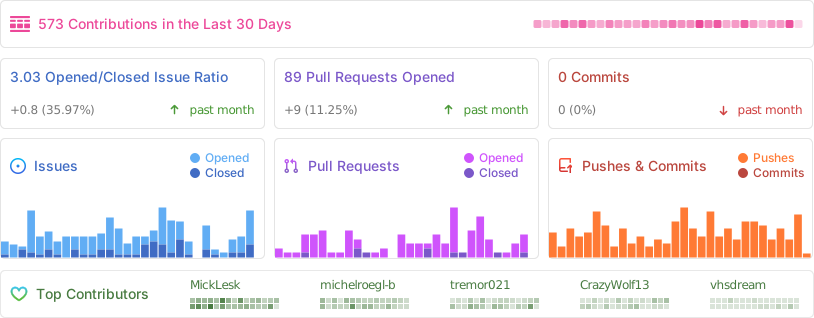
 MickLesk |
 michelroegl-brunner |
 BramSuurdje |
 CrazyWolf13 |
 tremor021 |
 vhsdream |
 asylumexp |
Project Activity
Support the Project
This project is maintained by volunteers. All infrastructure costs come out of pocket, and the work is done in people's spare time.
30% of all donations are forwarded directly to cancer research and hospice care — a cause that was important to tteck.


License
This project is licensed under the MIT License — free to use, modify, and redistribute for personal and commercial purposes.
See the full license text in LICENSE.
Maintained and expanded by the community · In memory of tteck
Proxmox® is a registered trademark of Proxmox Server Solutions GmbH